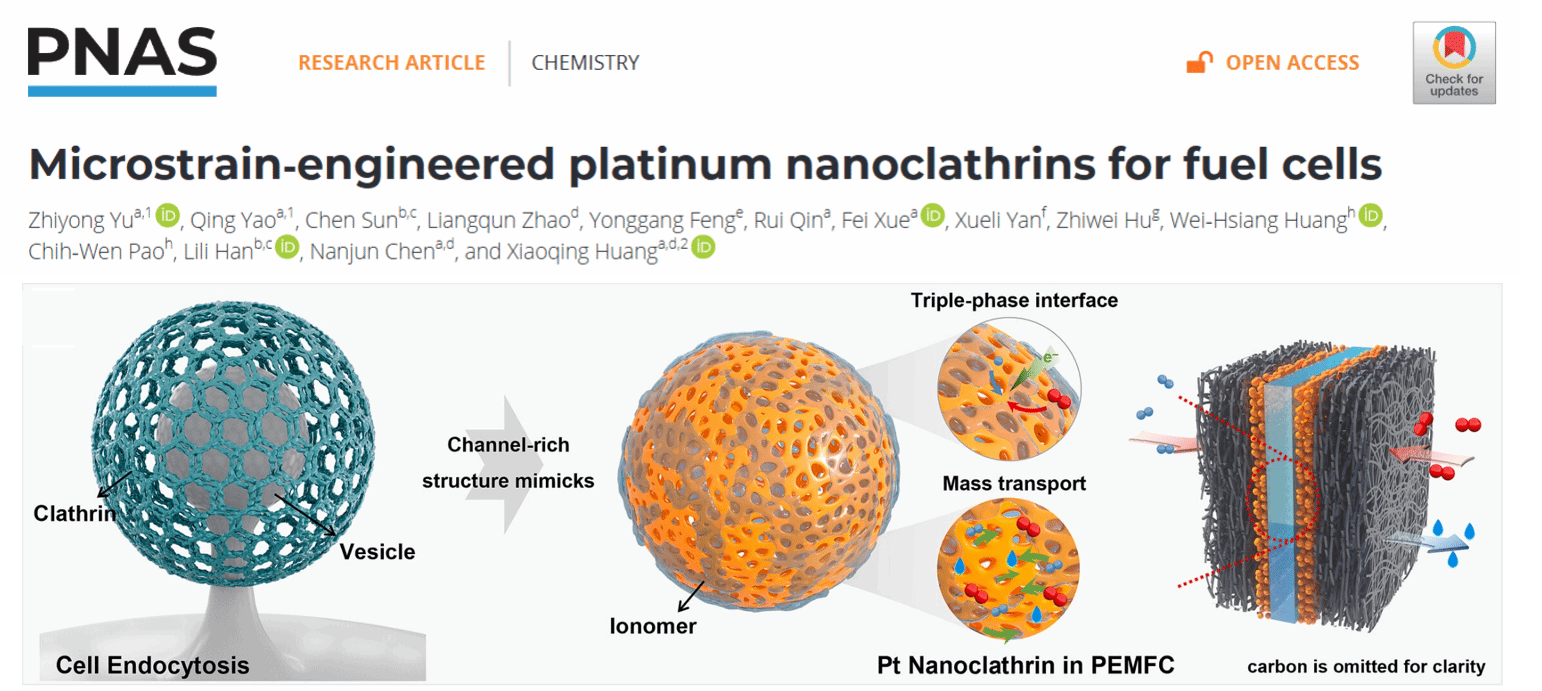
Artical Link: Microstrain-engineered platinum nanoclathrins for fuel cells
Proton exchange membrane fuel cells (PEMFCs) hold great promise for clean energy conversion, yet their performance is limited by insufficient mass transport bottlenecks within the catalyst layer. Addressing this fundamental issue demands innovative catalyst nanostructuring. Inspired by the evolutionarily optimized channel systems in cellular transport mechanisms, we design clathrin-mimetic noble metal nanostructures featuring nanoporous shells and internal cavities via a selenium-induced self-assembly method. The creation of such nanoclathrin relies on the in situ formed Se, where the amorphous structure induces the disordered growth of noble metals on the surface, ultimately establishing the nanoclathrin architecture. This strategy can be extended to create diverse nanoclathrins with controlled hollow size, shell thickness, as well as composition. Furthermore, precise microstrain engineering enables performance fine-tuning of platinum nanoclathrins (Pt NCLs) for half reactions in PEMFCs. Benefiting from enhanced mass transfer and optimized microstrain, Pt NCLs can serve as both efficient cathode and anode catalysts in practical fuel cells, achieving rated power densities of 1.25 W cm−2 in H2/O2 and 0.83 W cm−2 in H2/Air, which positions Pt NCLs among the best-performing pure-Pt catalysts and even rivals many state-of-the-art Pt-alloy catalysts. The clathrin-like structures also exhibit excellent stability, retaining 95.7% of their initial activity after 30,000 accelerated stress test cycles. This work highlights the significance of designing clathrin-like architecture with promoted mass transfer for practical devices and beyond in sustainable energy applications.