Artical Link: Integrating CO2 electroreduction with phenol hydrogenation on an oxygen-affinity tailored catalyst
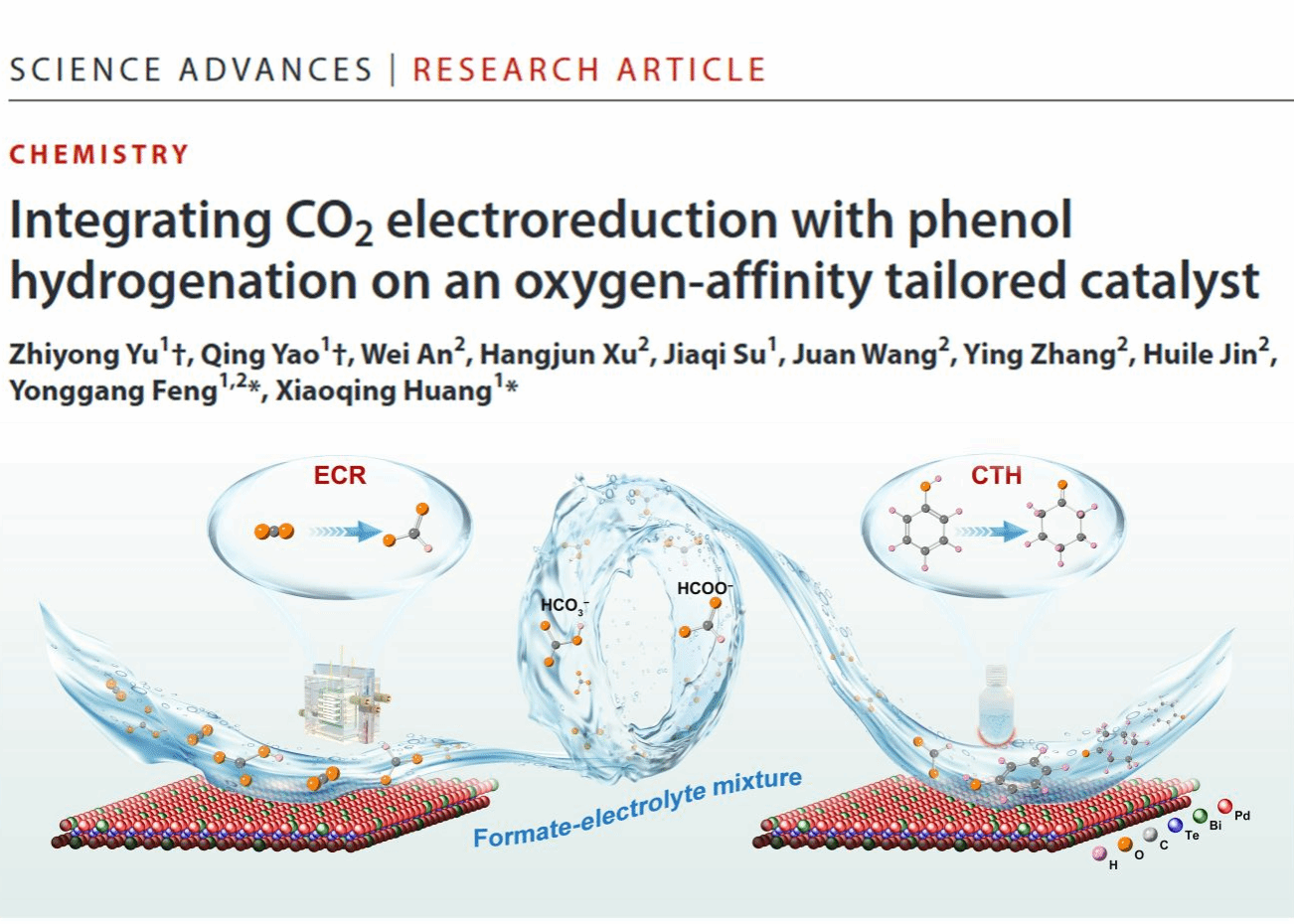
Electrocatalytic CO2 reduction (ECR) to formic acid faces challenges in separating and purifying a formate-electrolyte mixture. In situ utilization of this mixture presents a promising yet underexplored solution. Here, we report the synthesis of BixPd1−xTe nanocrystals (NCs) via a microwave-assisted cation topological exchange approach, enabling the precise tuning of surface oxygen affinities to simultaneously optimize the ECR and catalytic transfer hydrogenation (CTH) of phenol. Optimized Bi0.1Pd0.9Te NCs achieve a 92% formate Faradaic efficiency at −0.9 volts versus reversible hydrogen electrode and a production rate of 860 millimoles per hour per gram of catalyst at 100 milliamperes per square centimeter. This formate-electrolyte mixture serves as an effective hydrogen donor, enabling 98% selectivity toward cyclohexanone in phenol hydrogenation. Mechanistic studies show uniformly dispersed Bi sites create an oxygen affinity gradient, enhancing *OCHO adsorption for formate production and promoting noncoplanar phenol adsorption for selective cyclohexanone formation. This work pioneers synergistic ECR-CTH integration, establishing an innovative CO2 valorization and biomass upgrading strategy.